
What Is PITI in Real Estate? Meaning, Formula & Monthly Payment
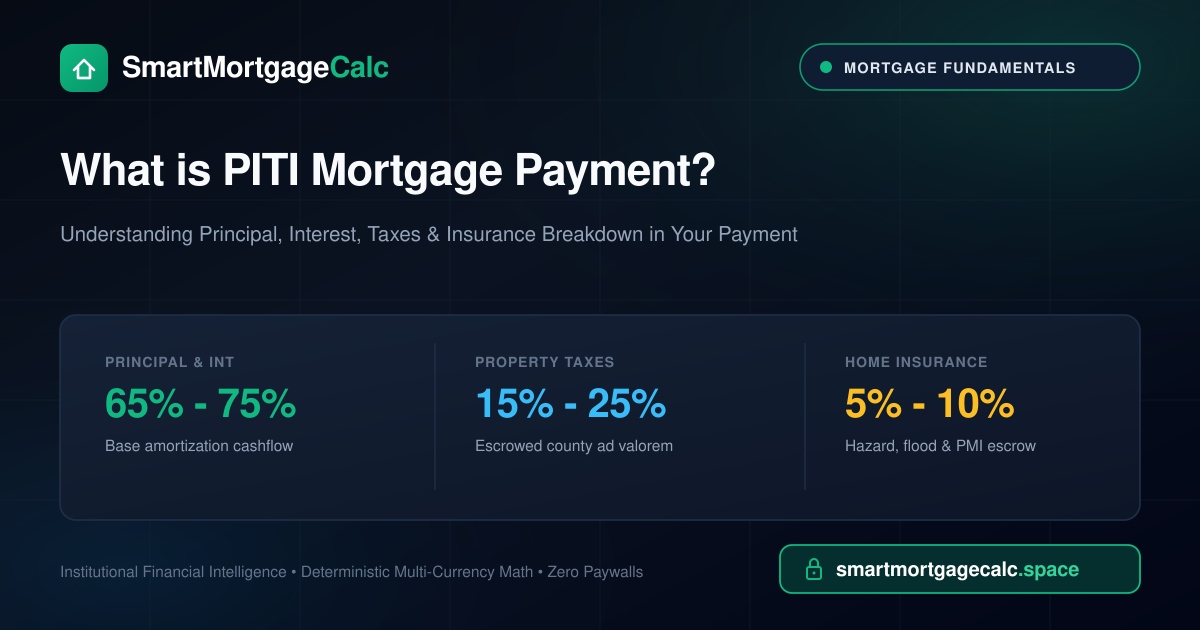
PITI stands for Principal, Interest, Taxes, and Insurance. In real estate, the PITI meaning represents the components that make up your total monthly housing cost. Mortgage underwriters use PITI calculations to determine your front-end debt-to-income ratio before pre-approval.
Worked examples on this page use an assumed 6.75% fixed interest rate and sample tax, insurance and PMI inputs. They are illustrations—not current market averages, quotes or a substitute for your Loan Estimate.
For example, a $360,000 loan (a $400,000 purchase with 10% down) at an assumed 6.75% APR has about $2,335 in monthly principal and interest. Add illustrative property taxes (~$367), homeowners insurance (~$125) and PMI (~$165), and the modeled total housing payment is about $2,992/month. Replace these estimates with your actual Loan Estimate and local tax and insurance figures.
When shopping for a home, nearly every advertisement highlights an enticing headline: "Own this home for just $2,490/month!" The full monthly payment can be higher once property taxes, homeowners insurance and any required mortgage insurance are included. That is why comparing only principal and interest can understate the cost of owning a home.
The Four Pillars of PITI Explained
1. Principal (P)
The Principal is the actual capital you borrowed to purchase the property. When you send your monthly payment, a portion directly chips away at this loan balance, building your home equity. In the early years of a 30-year amortization schedule, principal repayment represents only a small slice of your check, gradually expanding over time.
2. Interest (I)
Interest is the financial fee the lender charges you for borrowing their capital, expressed as an annual percentage rate (APR). In year one of a standard 30-year fixed loan, roughly 70% to 80% of your baseline payment is pure interest.
3. Taxes (T)
Property Taxes are assessed by your local county, municipal government, and school districts to fund local infrastructure, public schools, emergency services, and parks. Lenders usually require borrowers to pay one-twelfth (1/12th) of their annual tax bill into an escrow account each month.
Property-tax bills vary widely by county, assessed value, exemptions and local tax rates. Use the current tax bill or county assessor estimate for the property you are evaluating; a national shortcut can materially misstate the monthly payment.
4. Insurance (I)
The second "I" includes Homeowners Hazard Insurance, protecting the physical structure against fire, windstorms, and vandalism. Premiums depend on the property's location, replacement cost, coverage, deductible and catastrophe exposure. Use a current insurance quote rather than relying on a national estimate.
Visual Breakdown: What Makes Up Your Monthly PITI Payment?
PITI vs. P&I: What is the Critical Difference?
The difference between P&I (Principal & Interest) and PITI (Principal, Interest, Taxes, and Insurance) is the #1 reason first-time homebuyers experience payment shock after closing:
- P&I (The Bank's Base Loan Payment): Represents strictly the cost of repaying the debt itself. For an illustrative $400,000 loan at an assumed 6.75% fixed rate over 30 years, P&I is approximately $2,594 per month. Commercial bank commercials almost exclusively display this lower P&I figure.
- PITI: Includes P&I plus property taxes and homeowners hazard insurance. PMI, HOA dues and other recurring housing costs may increase the full monthly housing obligation, but they are not the four letters in PITI. The total depends on local taxes, insurance quotes and loan terms.
Real-World Example: The $400,000 Loan Breakdown
Here is an illustrative numerical example for a borrower with a $400,000 loan balance at an assumed 6.75% fixed interest rate over a 30-year term:
| Payment Component | Calculation Method | Monthly Amount | Share of Total |
|---|---|---|---|
| Principal & Interest (P&I) | Amortized at 6.75% over 360 mos | $2,594 | 75.2% |
| Property Taxes (1.35% avg) | $5,400/yr ÷ 12 | $450 | 13.0% |
| Homeowners Insurance | $1,800/yr ÷ 12 | $150 | 4.3% |
| PMI (0.75% for 10% down) | $3,000/yr ÷ 12 | $250 | 7.2% |
| Total Monthly Housing Payment (Including PMI) | All Escrow Components | $3,444 | 100.0% |
Protect Your Earnest Money: Include a PITI Financing Contingency
Never submit a purchase offer without a formal mortgage contingency clause. If local property taxes or insurance push your PITI over qualifying limits, an attorney-reviewed Real Estate Purchase Agreement allows you to walk away with 100% of your deposit intact.
Calculate Your Exact PITI Payment Now
Don't settle for incomplete estimates. Use our free, mathematical US Mortgage Calculator to factor in local tax rates, PMI, insurance, and HOA fees in seconds.
Open Free PITI Mortgage Calculator →Does PITI Include PMI?
No, not in the strict definition. PITI means principal, interest, property taxes and homeowners insurance. Private mortgage insurance (PMI) is a separate cost, as are HOA dues. Lenders may include these additional recurring expenses when assessing the full housing payment or PITIA, depending on the loan program and underwriting method.
When comparing mortgage estimates, check whether PMI and HOA dues are included in the quoted monthly total. Read our PMI guide for cancellation rules.
What About PITIA? (Adding HOA and PMI)
In modern underwriting, mortgage originators frequently use the acronym PITIA:
- A = Assessment / HOA Fees: If you purchase a condominium, townhouse, or single-family home in a planned community with amenities, Homeowners Association (HOA) dues are legally binding. While not always held in escrow, underwriters treat them as a mandatory debt payment when verifying your 28% front-end debt ratio.
- Private Mortgage Insurance (PMI): If your down payment is less than 20% on a conventional loan, monthly PMI premiums are added to your escrow until you reach 20% equity.
How Underwriters Use PITI: The 28/36 Rule
Mortgage lenders evaluate your capacity to handle PITI through two benchmark ratios:
- Front-End Ratio (The 28% Rule): Your complete PITI payment should not exceed 28% of your gross monthly household income. For instance, if you earn $10,000 per month gross, your maximum recommended PITI is $2,800.
- Back-End Ratio (The 36% Rule): Your PITI plus all recurring monthly debt (student loans, car notes, minimum credit card payments) should not exceed 36% to 43% of your gross monthly income.
Frequently Asked Questions About PITI
What does PITI stand for?
PITI stands for Principal, Interest, Taxes, and Insurance. It represents the four fundamental components that make up a borrower's complete monthly mortgage payment.
Can my PITI payment change on a fixed-rate mortgage?
Yes. Even if your interest rate and Principal & Interest payment are locked for 30 years, your total PITI will fluctuate when your local county reassesses property values or your home insurance carrier increases premiums.
Do all homeowners have to pay PITI in one single check?
Most lenders require an escrow account for borrowers putting down less than 20%. If you put down 20% or more, some lenders allow you to pay property taxes and insurance directly to municipal tax collectors and insurance companies, meaning your monthly mortgage check covers only Principal and Interest.
Published by SmartMortgageCalc. Worked examples are illustrative; verify your actual payment with a current Loan Estimate, local property-tax information and a homeowners-insurance quote.
Cite this guide: SmartMortgageCalc, "What Is PITI in a Mortgage? Meaning, Formula & Monthly Payment", https://smartmortgagecalc.space/blog-what-is-piti (September 2026).