
Key Financial Takeaways (Executive Summary)
- Mortgage amortization is mathematically engineered so that interest is calculated on the remaining unpaid principal balance every month.
- In year 1 of a 30-year 6.5% mortgage, over 74% of every dollar you pay goes directly to lender interest.
- In the illustrative 30-year loan shown below, the principal portion becomes larger than the interest portion around Year 18; the exact month depends on the rate and loan terms.
- Extra principal payments can reduce future interest and shorten the payoff period, but the benefit should be weighed against liquidity needs, other debts, taxes, and any loan-specific prepayment terms; it is not the same as a guaranteed investment return.
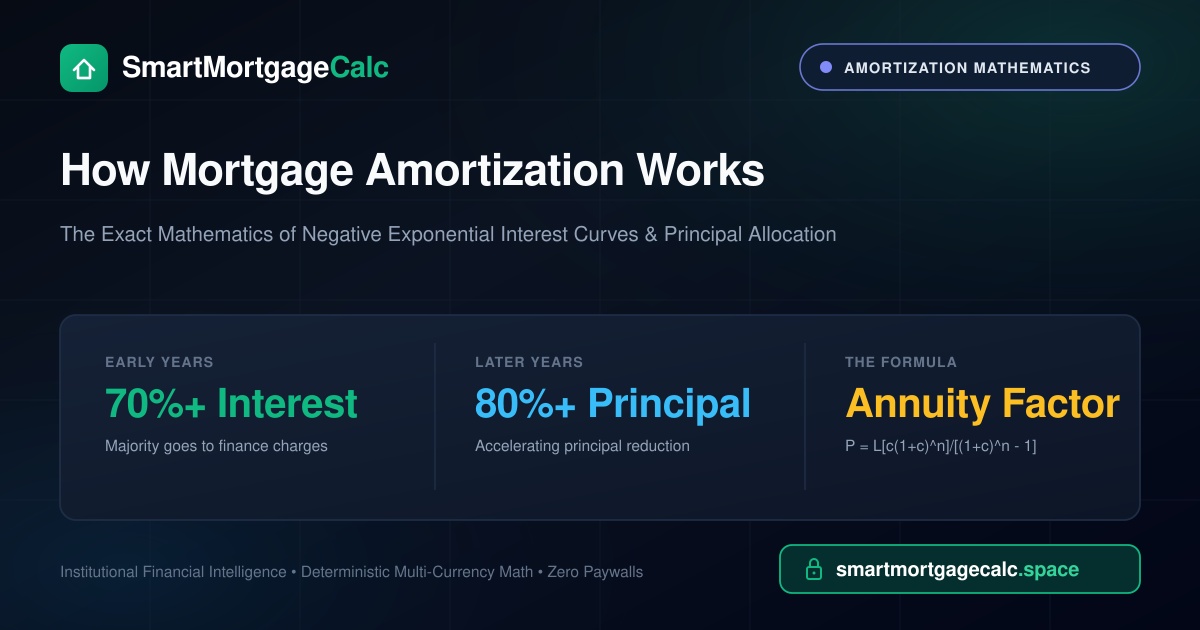
The Anatomy of an Amortizing Loan
The word amortization derives from the Latin root ad-mort, meaning "to put to death." In finance, an amortized loan is a structured debt where regular, equal monthly payments are calculated to pay off both principal and interest entirely by the final maturity date.
While your monthly Principal & Interest payment remains constant every single month for 30 years, the internal composition of that payment shifts continuously:
- Early Years: The unpaid loan balance is massive, so the monthly interest charge is massive. Principal reduction is negligible.
- Middle Years: The balance slowly declines, interest decreases, and principal reduction picks up velocity.
- Final Years: The balance is low, monthly interest is tiny, and almost your entire payment goes directly to equity.
🧮 Full 30-Year Month-by-Month Amortization Schedule Generator
Generate and export your complete principal-reduction schedule with printable tables and breakdown visualizers.
Generate Amortization ScheduleThe Actuarial Formula: Behind the Numbers
Lenders calculate your fixed monthly payment using the standard annuity payment equation:
Where P is the loan amount, r is the monthly interest rate (annual rate / 12), and n is the total number of monthly payments (360 for 30 years).
Worked example: $350,000 at 6.50% for 30 years
With P = $350,000, monthly rate r = 0.065 / 12, and n = 360 payments, the monthly principal-and-interest payment is about $2,212.24.
- Month-one interest: $350,000 × 0.065 ÷ 12 = $1,895.83.
- Month-one principal: $2,212.24 − $1,895.83 = $316.41.
- New balance after payment one: $349,683.59.
Taxes, homeowners insurance, PMI, HOA dues and lender fees are not part of the principal-and-interest formula. Open the amortization schedule calculator for the full month-by-month breakdown.
Year-by-Year Breakdown on a $350,000 Loan at 6.50%
Monthly Principal & Interest payment: $2,212.24.
| Year | Monthly Payment | Avg Monthly Principal | Avg Monthly Interest | % to Interest | Remaining Balance |
|---|---|---|---|---|---|
| Year 1 | $2,212.24 | $332.18 | $1,880.06 | 85.0% | $345,910 |
| Year 5 | $2,212.24 | $431.14 | $1,781.10 | 80.5% | $326,712 |
| Year 10 | $2,212.24 | $596.11 | $1,616.13 | 73.0% | $294,228 |
| Year 15 | $2,212.24 | $824.23 | $1,388.01 | 62.7% | $249,325 |
| Year 18 (Tipping Point) | $2,212.24 | $1,118.40 | $1,093.84 | 49.4% (Equity Flips) | $201,840 |
| Year 25 | $2,212.24 | $1,642.10 | $570.14 | 25.8% | $95,210 |
| Year 30 | $2,212.24 | $2,165.40 | $46.84 | 2.1% | $0 (Paid Off) |
How to Defeat the Amortization Curve
Because interest is calculated every single month based on the remaining principal, making extra payments early in the loan has a disproportionate, compounding effect:
- One Extra Payment Per Year: By dividing your monthly payment by 12 and adding that amount each month (e.g. an extra $184/month on a $2,212 payment), you shave 4.8 years off your mortgage and save over $82,000 in interest.
- Lump-Sum Prepayment: A single $10,000 extra principal payment made in Month 12 saves over $45,000 in interest across the remainder of the loan.
Generate Your Custom 360-Month Amortization Schedule
View your month-by-month and year-by-year principal vs interest payoff schedule with our institutional Actuarial Amortization Table.
Generate Live Amortization ScheduleFrequently Asked Questions
Banks do not artificially front-load interest out of greed; it is a mathematical consequence of how debt balances work. When you owe $350,000, 6.5% interest on $350,000 is $1,895 per month. As you pay the balance down to $100,000, 6.5% interest is only $541 per month. Because your total payment is fixed, whatever is left over after paying interest goes to principal.
🧮 Generate Amortization Schedule →